Transport and Logistics Services Explained: How to Choose the Right Partner in the UK

Transport and logistics services are essential for UK businesses that rely on efficient movement of goods. Before selecting a provider, it’s important to understand what transport and logistics services include and how the right partner supports business growth.

Making the right choice of transport and logistics company partner can directly affect your business’s ability to perform efficiently. Completion of cost assessments and the level of customer satisfaction are crucial. In the UK and its comparatively competitive supply chain environment, selecting a trustworthy provider for transport and logistics services means your goods are also moving on time. You are meeting regulatory requirements and limiting the headaches caused by your supply chain. Investing your time running a company that is well-experienced. All-encompassing transport & logistics services providers can benefit your business’s budget and bottom line by delivering much more than just ‘deliveries.’

What Are Transport and Logistics Services?

Transport and logistics services cover the planning, movement, storage, and delivery of goods from one location to another. Transport focuses on physically moving goods using vehicles such as vans, trucks, or HGVs, while logistics involves coordination, scheduling, warehousing, and inventory management. For UK businesses, effective transport and logistics services ensure goods arrive on time, supply chains remain efficient, and regulatory requirements are met. Whether it involves domestic road transport, freight movement, or specialist haulage, understanding these services helps businesses choose the right provider for their operational needs.
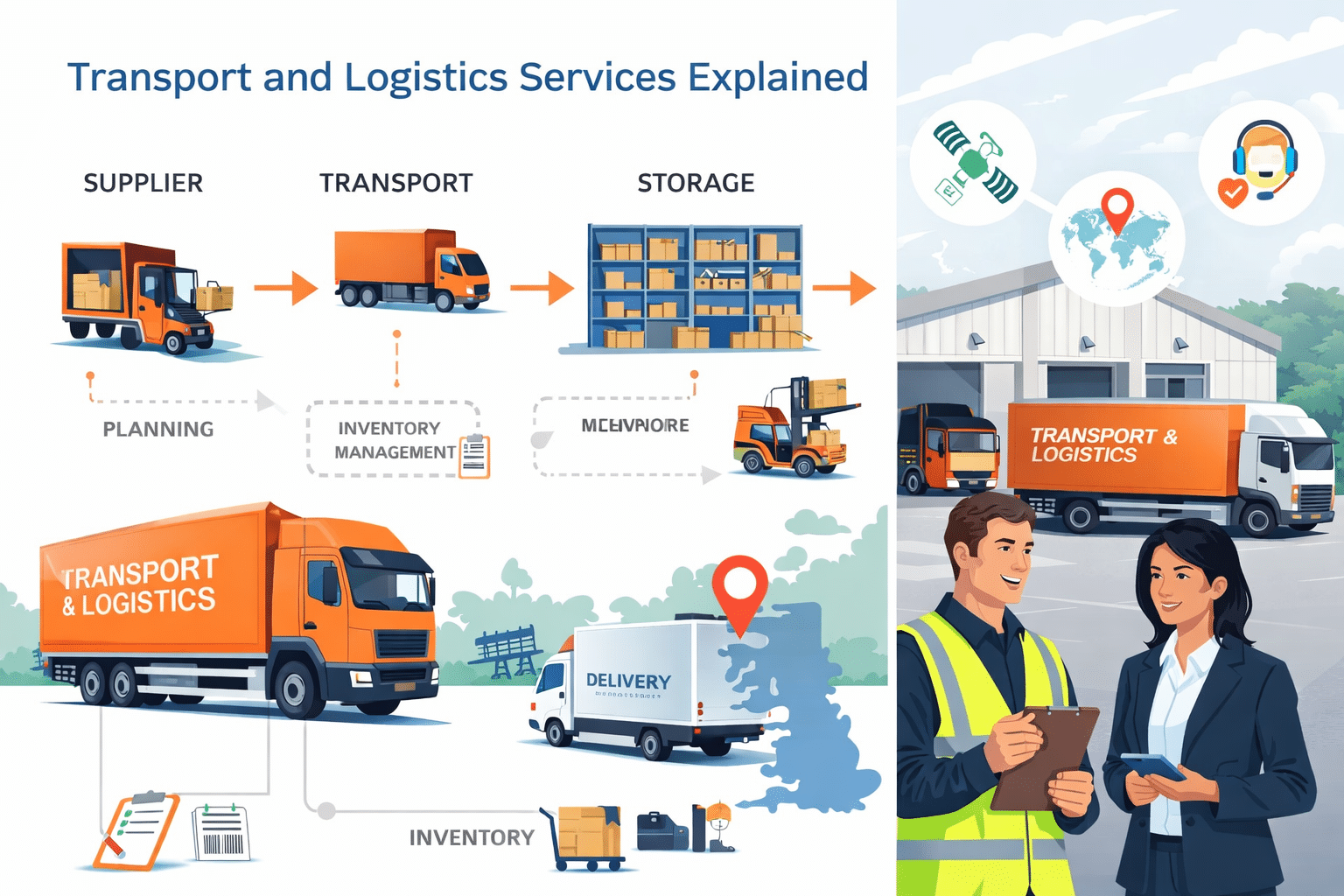
transport and logistics services explained

Why Choosing the Right Transport & Logistics Partner Matters

An effective Transport & Logistics Services UK partner serves as the cornerstone of any commercial operation. If you select the incorrect partner, they can slow down supply chains, raise costs, and risk customer trust. In contrast, the right provider will produce a flawless flow of goods while minimizing compliance and security risks. The role of transport and logistics in business operations Transport and logistics services affect almost every area of your business:

  • Supply chain effectiveness: Efficient logistics will keep inventory flowing, avoid stockouts, and allow for on-time manufacturing.
  • Timeliness of delivery: Fast and dependable deliveries will improve customer satisfaction and retain customers.
  • Inventory Management: Smooth transportation results in accurate stock levels and less waste.
  • Operational flow: Transport logistics services will avoid bottlenecks so departments run smoothly. 

How the wrong provider causes delays, losses & compliance issues

A bad logistics partner can certainly lay you open to large risks. 

Such risks are: 

  • Deliveries are late & damage customer confidence. 
  • Goods are damaged or lost because of poor abilities, unskilled staff, or improper packaging. 
  • Vehicles are out of compliance with DVSA regulations, or local UK requirements.
  • Vehicles that do not comply with DVSA regulations or local UK laws.
  • Missing paperwork related to Brexit/customs that causes fines or delays crossing the border.
  • A schedule that has been improperly managed, affecting a production or sales cycle.  
  • Non-compliant vehicles or a lack of DVSA-approved standards can also expose businesses to legal risks and costly delays.

All of these issues are costly, and all can be avoided by choosing the right provider.

Key Factors to Consider Before Selecting a Logistics Partner

1) Range of Services Offered (Transport, Haulage & Logistics)

A logistics partner that offers a wide range of services can support businesses more effectively. This includes domestic road transport services, freight forwarding, pallet delivery, same-day or urgent deliveries, and secure warehousing solutions. Working with a provider that offers multiple services under one roof allows businesses to streamline operations and adapt to changing delivery requirements.

2) Knowledge of the Industry & History

Having knowledge is an asset.  Providers with experience in years of knowledge about the UK transport companies industry are aware of:

  • The UK road networks and delivery routes.
  • Deliveries to the EU and customs regulations.
  • Transporting temperature-sensitive goods, or fragile goods.
  • Transporting specialized equipment.

Having industry-specific knowledge will cause items to be safer to arrive and on time, while reducing compliance risk. Experienced providers understand UK road networks, customs requirements, and industry-specific handling needs, which reduces delays and operational risks.

3) Quality of Fleet & Having Safe Vehicles

The fleet quality of your provider will change how efficient and reliable it is going to be.

  • Up-to-date and serviced vehicles means a breakdown isn’t likely to happen.
  • DVS compliant trucks for getting into London safely.
  • Having GPS tracking means you can micro-manage deliveries in real time.
  • Different peculiar load capacities for any kind of goods.

Having a quality fleet improves safety, efficiency, and timeliness. A modern, well-maintained fleet that meets DVS requirements and includes GPS tracking improves safety, reliability, and delivery accuracy

4) Delivery Speed: Same Day, Next Day & Scheduled

Delivery speed plays a key role in customer satisfaction and operational efficiency. Same-day or urgent delivery services are often required for time-sensitive shipments, while next-day and scheduled deliveries suit regular supply chain needs. For example, businesses in Oxford often depend on same-day delivery services to meet urgent freight deadlines and avoid operational delays.

5) Safety, Security & Compliance

Safety and compliance brings with it trust:

  • Driver training is in accordance with standards for safe handling of cargo.
  • Goods-in-transit insurance protection for monetary loss.
  • UK transport compliance and driver safety standards (industrial equipment transportation laws in the UK in relation to HGV, paperwork in relation to Brexit, compliance in relation to DVSA).


They all provide a degree of risk mitigation, which leads to feeling more about the logistics partner and their ability to deliver.

6) Pricing Transparency & Hidden Costs

Transport costs depend on things like fuel, distance, urgency, tolls, and the size of your load. Going for the cheapest option might seem tempting, but it can come with hidden fees or unreliable service. Clear, transparent pricing shows all costs upfront, so you know exactly what you’re paying. Before choosing a provider, ask about fuel surcharges, tolls, handling fees, and charges for urgent deliveries. Transparent pricing helps you plan your budget better and avoids any unpleasant surprises along the way.

7) Customer Support & Communication

Good communication makes logistics simple and stress-free. Having a dedicated account manager means you always have one person to turn to for any questions. Fast response times ensure problems are dealt with quickly, while real-time tracking keeps you updated on your shipments at every stage. Quick and effective problem-solving helps fix delays or mistakes without hassle. Clear communication builds trust, reduces uncertainty, and gives you confidence in your logistics partner.

Checklist to Choose the Right Transport & Logistics Company in the UK

Before finalizing a logistics provider, UK businesses should review the following checklist to ensure reliability, compliance, and long-term suitability:

  • Clear understanding of transport and logistics services offered
  • Compliance with UK regulations and DVSA standards
  • DVS-compliant fleet for operating in London and surrounding areas
  • Modern, well-maintained vehicles with GPS tracking
  • Transparent pricing with no hidden charges
  • Proven experience in domestic and freight delivery within the UK
  • Real-time tracking and responsive customer support
  • Flexibility to handle urgent or same-day delivery requirements

Why UK Businesses Trust Local Transport Partners

Local transports and delivers parcels providers in the UK unique benefits:

  • Better knowledge of local routes → faster and more reliable deliveries.
  • Reduced times for collection and delivery.
  • Lower cost of operations.
  • Ability to quickly accommodate last minute changes.
  • Stronger partnerships and trust.
  • Easier to communicate with.

For instance, a manufacturing firm in Birmingham was able to avoid delays, at least in comparison to competitors that were not domestic logistics solutions partners, during peak season by having the logistics partner that understood traffic patterns and regulatory checkpoints.

FAQ’s

1. Why is tracking important in logistics?

With tracking, logistics provide a clearer view of all shipments, with the added benefit of being able to receive real-time updates for each shipment. This means that companies are now able to track their shipments as they move through the supply chain. Therefore, plan their inventories more precisely and to make timely decisions to minimize potential shipment delays or losses. Furthermore, when customers receive reliable shipping information about the status of their orders, it enhances the likelihood of providing excellent customer service.

A Logistics Service Provider (LSP), it is important to evaluate the LSP’s fleet quality. The LSP’s experience/level of service provided; what types of services are available; how much they will charge for the services offered; and whether or not they respond quickly to customer inquiry. An LSP should follow all applicable transportation laws/regulations; provide safe and secure handling of all products transported. There use best practice to ensure that their transportation and logistics service continues to meet the needs for all customers consistently and on-time. By choosing an LSP with these attributes, a business will be able to sustain the timely delivery of their products. Maintain the integrity of their brand, and improve the overall efficiency of their supply chain.

Transport and logistics services consist of multiple modes; for instance: road transport, pallet delivery, haulage, storage, same-day delivery service, and freight forwarding, among others. An LSP that can offer businesses access to multiple modes of transport and logistics services can enable businesses to combine multiple shipments, to reduce overall costs, as well as support flexible capabilities for meeting delivery dates. An LSP that can provide a broad range of transport and logistics services can better accommodate a business’s needs.

The purpose of the DVS kit (Direct Vision Standards kit) is to allow drivers to clearly see other road users, for example pedestrians and cyclists. The DVS standard was created in London to help increase safety for vulnerable road users through heavy goods vehicles (HGVs). All organisations that provide HGVs with DVS kits must have procedures in place to ensure the health and safety of themselves and other road users, and they must be in compliance with the UK law regarding the safe operation of this equipment.

Flexible delivery schedules (allowing multiple deliveries at one time), planned shipment dates (pre-scheduled shipments), long-term contracts (for example, annual contracts), and avoidance of peak hour delivery will often yield better freight rates. If you are able to commit to delivering a consistent volume of freight over time, it will often reduce your freight costs. Planning deliveries, avoiding emergency and/or last-minute shipments, and effectively negotiating with your freight provider can lead to significant improvements in your shipping costs while still offering a reliable service.

Last Updated : January 2026 This guide is written by UK logistics professionals with hands-on experience in transport operations, compliance standards, and supply chain management.